
Optical transceivers play a pivotal role in shaping our interconnected world. These remarkable devices serve as both a transmitter and a receiver of data. They are efficient yet portable, sending and receiving data at incredibly high speeds and across long distances. In this post, we will learn more about optical transceivers and their applications.
What Are Optical Transceivers?
Optical transceivers are compact yet powerful devices that utilize light pulses to transmit and receive data. They facilitate bidirectional communication over optical fiber networks and convert electrical signals into light or optical signals. They are crucial components in telecommunications, data centers, and various networking applications where high-speed and long-distance data transmission is paramount. In essence, these transceivers merge the functionalities of both a transmitter and a receiver, making them a vital bridge in modern communication systems.
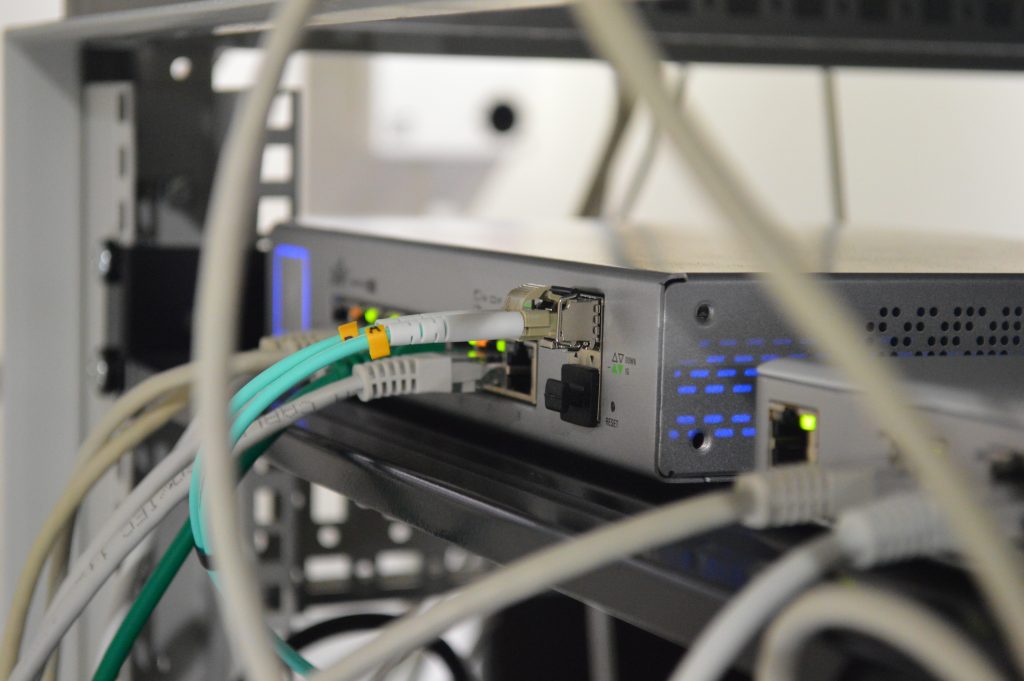
At the heart of every optical transceiver lies a transmitter and a receiver, each with a specific role to play.
Transmitter: The transmitter’s mission is to convert electrical signals into optical signals. This process involves using a laser or a light-emitting diode (LED) to generate light at precise wavelengths. The electrical data signals are then cleverly encoded onto the light, creating an optical signal that holds the data.
Optical Fiber: The optical signal, now carrying vital data, embarks on its journey through an optical fiber. These slender strands, often made of glass or plastic, are designed to ferry light over great distances with minimal loss of signal quality.
Receiver: At its destination, the optical signal encounters the receiver. Here, a photodetector, typically a photodiode, shines. The photodetector transforms the incoming light signals back into electrical signals. This marks the triumphant return of the data to the world of electrons, ready to be processed and interpreted by the receiving device.
Form Factors and Versatility
Optical transceivers come in various types, each tailored for specific data rates, distances, and applications. Here are some common form factors you might encounter:
SFP: Small Form-Factor Pluggable optical transceivers, such as the ACC-6081A, are particularly suited for shorter distances and lower data rates within local networks and data centers.
QSFP: Quad Small Form-Factor Pluggable optical transceivers like the ACC-6077A offer higher data rates, shining in both short and medium distances within data centers.
CFP: C Form-Factor Pluggable transceivers are often used in telecommunications networks due to their ability to handle both high data rates and long distances.
XFP: 10-Gigabit Small Form-Factor Pluggable transceivers are a reliable choice with a data rate of 10 Gbps across a variety of applications.
CXP: 100-Gigabit Form-Factor Pluggable transceivers are a common choice for applications that require high-speed connections across a short distance.
QSFP28 (and SFP28): A Quad Small Form Factor Pluggable transceiver, like the ACC-6095A, has four channels and is designed for 100 GbE data transfer.
These form factors accommodate a wide range of needs, from local networks to sprawling global connections.
In a world where speed and reliability are paramount, optical transceivers provide the bedrock for seamless data transmission. Their ability to harness light as a medium has revolutionized the way we communicate and connect. From streaming movies to global video conferences, these unassuming devices work tirelessly behind the scenes, enabling the digital interactions that define our modern lives.
Additional Information: